Field Trips
Post-Meeting Field Trip FT4: TRANSECT THROUGH VARDAR MEGA SUTURE ZONE
Field Trip Details
Contact person:
Dejan Prelević (dejan.prelevic@rgf.bg.ac.rs)
Leaders:
Dejan Prelević, Ana Mladenović, Kristijan Sokol
Duration/Date:
3 days
19 September 2026 – 21 September 2026
Departure / final point:
Vrdnik – Brzeće/Kopaonik – Zlatar/Zlatibor – Bistrica/Priboj – Belgrade
Price:
340 EUR (double room)
Deadline: 1 July 2026
Participants:
Minimum 16, maximum 36
Description
Although the Mesozoic evolution of the central Balkan Peninsula has been extensively studied, key questions remain regarding the number of oceanic domains and the timing of the final closure of the Neotethys Ocean. In particular, there is ongoing debate as to whether Neotethys closed in the latest Jurassic–earliest Cretaceous, or whether a remnant ocean — the so-called Sava Ocean — persisted until the latest Cretaceous.
This three-day field excursion will cross the former suture zone from the European margin toward the Adriatic (African) plate. Participants will examine ophiolites accreted to the European continental margin, ophiolites obducted onto the Adriatic passive margin, ophiolitic mélanges, and overstep sequences that provide crucial constraints for reconstructing the region’s geodynamic history.
The excursion begins at Fruška Gora, with the first stops located in outcrops of the Eastern Vardar Ophiolitic Belt – a unit accreted to the European margin and representing the westernmost part of the Carpatho-Balkan orogen during Alpine orogenesis. We will observe characteristic Eastern Vardar ophiolitic lithologies, as well as their predominantly Lower Cretaceous sedimentary cover, commonly referred to in the regional literature as the paraflysch unit.
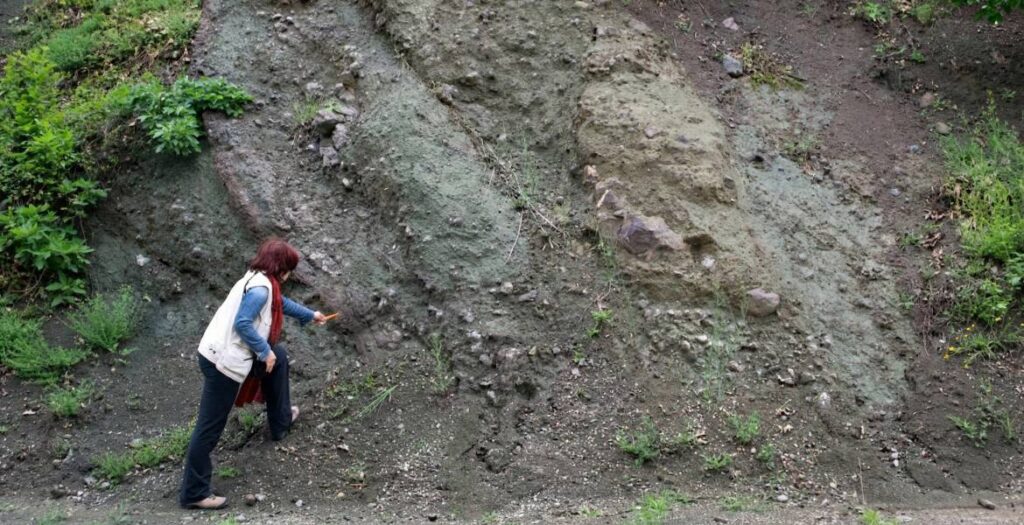
Across the suture zone, our excursion will gradually transition onto the former passive margin of Adria. Here, the suture is marked by an unusual turbiditic succession containing brecciated ophiolitic fragments incorporated as clasts within Scaglia-type limestones — a key indicator of late-stage tectonic mixing and sedimentation.
Further along the Adriatic margin, participants will be able to see the basement of Adriatic-derived units and examine deformation structures associated with the closure of the Neotethys Ocean and the subsequent nappe stacking during collision between the Adriatic microcontinent and continental units of European affinity. A significant portion of the excursion will be devoted to examining various expressions of the Western Vardar ophiolites, including metamorphic soles, tectonic mélanges, and large peridotite bodies — all essential for understanding the contrasting styles of ophiolite emplacement along the convergent margin.