
Field Trips

Pre-Meeting Field Trip FT3: One-Day Field Excursion through the Serbian Carpathians: Preliminary Proposal
Field Trip Details

Contact person:
Uroš Stojadinović (uros.stojadinovic@rgt.bg.ac.rs)

Leaders:
Uroš Stojadinović, Maja Maleš, Nikola Randjelović

Duration:
1 day

Departure / final point:
?

Price:
?

Participants:
Minimum 16, maximum 36

Description

The Serbian Carpathians represent a segment of the Alps-Carpathians-Dinarides orogenic system in southeastern Europe. From west to east, the thrusted orogenic sequence of the Serbian Carpathians comprises segments of the Supragetic and Getic Units, as parts of the Dacia mega-unit; the ophiolite-bearing Ceahlău-Severin Unit; and the Danubian Unit, which originated from the Moesian foreland. This excursion provides an overview of their structural, stratigraphic, and magmatic relationships along the Danube gorge.

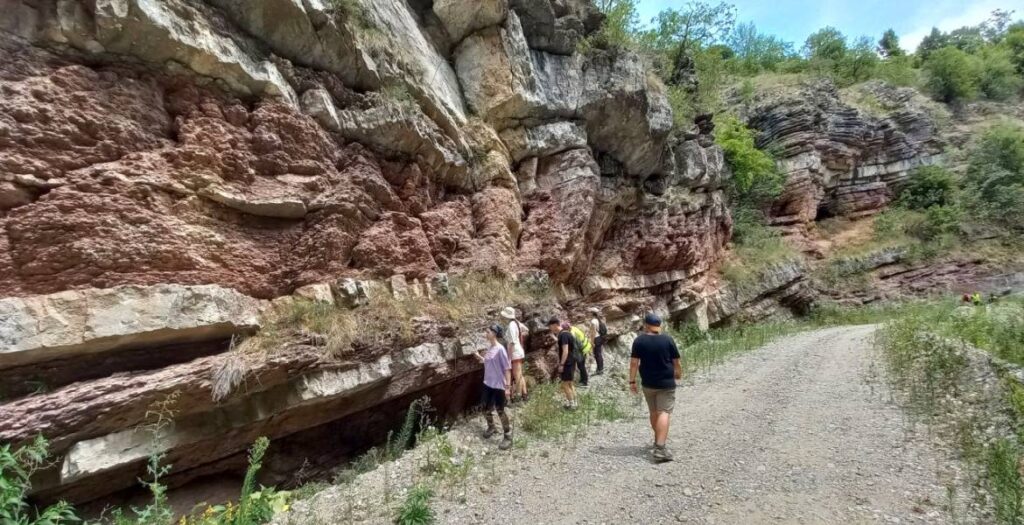
The one-day field trip will start from Belgrade on September DD, 2026, and traverse the principal tectonostratigraphic units of the Serbian Carpathians. At stop 1, we will examine the thrust contact between the Supragetic metamorphic basement in the hanging wall and the deformed Mesozoic carbonates of the Getic Unit in the footwall — a key exposure illustrating late Early Cretaceous nappe stacking within the Dacia mega-unit. At the entrance to the Iron Gates (stop 2), participants will observe well-exposed Mesozoic platform carbonates of the Getic Unit. The stop will also include a short cultural visit to the medieval Golubac Fortress, located at the westernmost narrowing of the Danube gorge. Continuing eastward, at stop 3, we will see outcrops where the metamorphic basement of the Getic Unit is intruded by a Variscan granitoid, demonstrating the pre-Alpine magmatic imprint on the Dacian crust. At stop 4, in the Donji Milanovac area, we will study Jurassic to Lower Cretaceous radiolarian cherts and deformed carbonates, representing the Mesozoic sedimentary cover of the Danubian Unit. These successions record the transition in depositional environments during the evolution of the Ceahlău–Severin Ocean. In the Boljetinska reka gorge (stop 5), we will again examine the upper part of the Mesozoic cover of the Danubian Unit. The final stop 6 will expose the metamorphic basement of the Danubian Unit, intruded by a dyke of Banatites, which represents the northeasternmost occurrence of magmatics widely exposed in the Late Cretaceous Timok Magmatic Complex. On the return to Belgrade, the group will visit the archaeological site of Lepenski Vir, one of Europe’s most significant Mesolithic–Neolithic settlements, offering a broader cultural and historical perspective to the day’s geological program.