Field Trips
Pre-Meeting Field Trip FT1: CENOZOIC MAGMATISM AND METALLOGENY: INSIGHTS FROM THE RUDNIK VOLCANO–INTRUSIVE COMPLEX (CENTRAL SERBIA)
Field Trip Details
Contact person:
Stefan Petrović (stefan.petrovic@rgf.bg.ac.rs)
Leaders:
Stefan Petrović, Miloš Velojić, Vladica Cvetković
Duration/Date:
2 days
15 September (09:00) – 16 September 2026
Departure / final point:
Belgrade – Borač – G. Milanovac – Rudnik – Vrdnik
Price:
220 -240 € (double room)
Deadline: 1 July 2026
Participants:
Minimum 12, maximum 16
Description
This field excursion provides a comprehensive geological overview of central Serbia, with a focus on the Rudnik volcano–intrusive complex within the Serbo-Macedonian metallogenic province. The region offers an excellent example of the interplay between Tertiary magmatism, tectonics, and ore formation.
The Serbo-Macedonian metallogenic province developed along the central axis of the Balkan Peninsula following the closure of the Tethys Ocean, within the framework of the Alpine–Himalayan orogenic system. Magmatic activity during the Oligocene and Miocene (~33–20 Ma) exhibits a wide compositional spectrum, ranging from basalts to rhyolites and from tholeiitic to alkaline series. This magmatism is closely associated with hydrothermal ore systems enriched in Pb, Zn, Sb, Bi, Ag, As, Cu, and Au.
The Rudnik complex exemplifies the evolution of magmatic activity through two main phases. The Oligocene phase (~30 Ma) is characterized by extrusive and shallow intrusive dacitic and andesitic rocks, whereas the Miocene phase (~23 Ma) produced a diverse suite of volcano igneous and intrusive quartz-latite facies.
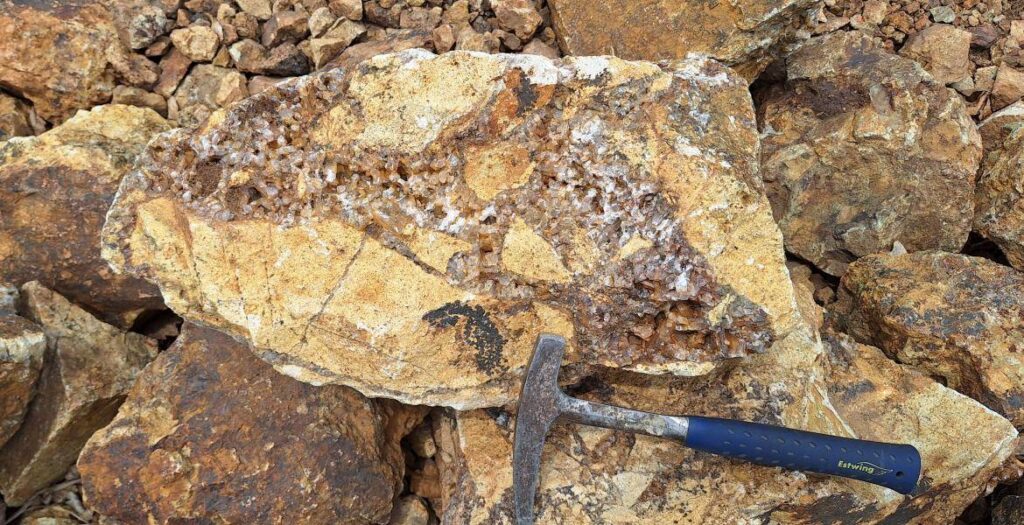
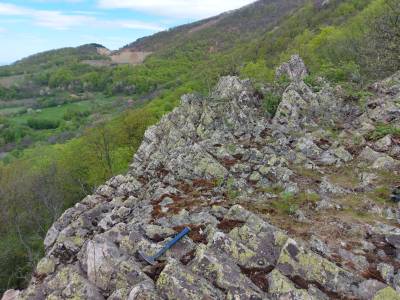
During the excursion, participants will visit several outcrops illustrating volcanic flows, shallow quartz-latite intrusions (dykes and sills), and a well-preserved volcano–sedimentary diatreme. These features provide valuable insight into the structural controls on magmatic emplacement and their relationship to hydrothermal ore formation.